TasteFinder: Designing the Semantic Restaurant Guide
A case study on designing an AI-powered recommendation system that bridges the gap between nuanced human intent and structured data.
The Problem
Most restaurant discovery platforms rely on rigid filters, star ratings, and keyword search. While these approaches help narrow down a list of 500 restaurants to 50, they fundamentally struggle to understand human context.
When a user searches for a "quiet, budget-friendly cafe suitable for a 3-hour remote work session," standard platforms break down. Users are forced to manually stitch together information from multiple sources, read conflicting reviews, and endure decision fatigue.
Target Users
- The Planner: Busy professionals tasked with organizing team dinners or client meetings with specific requirements.
- The Experience Seeker: Food enthusiasts looking for a highly specific vibe (e.g., "romantic rooftop for a first anniversary").
- The Utility Diner: Users seeking functional spaces like remote-work friendly cafes with reliable WiFi and plug points.
Market Opportunity
There is a massive shift happening in consumer technology from "Keyword Search" to "Semantic Search." The opportunity was to build a product that doesn't just return a list of locations, but actively curates and explains the recommendations based on the user's specific conversational intent.
Research Insights
During the discovery phase, three core behavioral insights drove the product design:
Users think in occasions, not tags
A user doesn't think, "I want a restaurant with the tags: Italian, $$$$, Outdoor Seating." They think, "I want to impress my partner on our anniversary."
The Paradox of Choice
Showing a user 25 "highly rated" restaurants actually increases anxiety. Users prefer 3 highly curated options with a clear explanation of why they fit.
User Journey
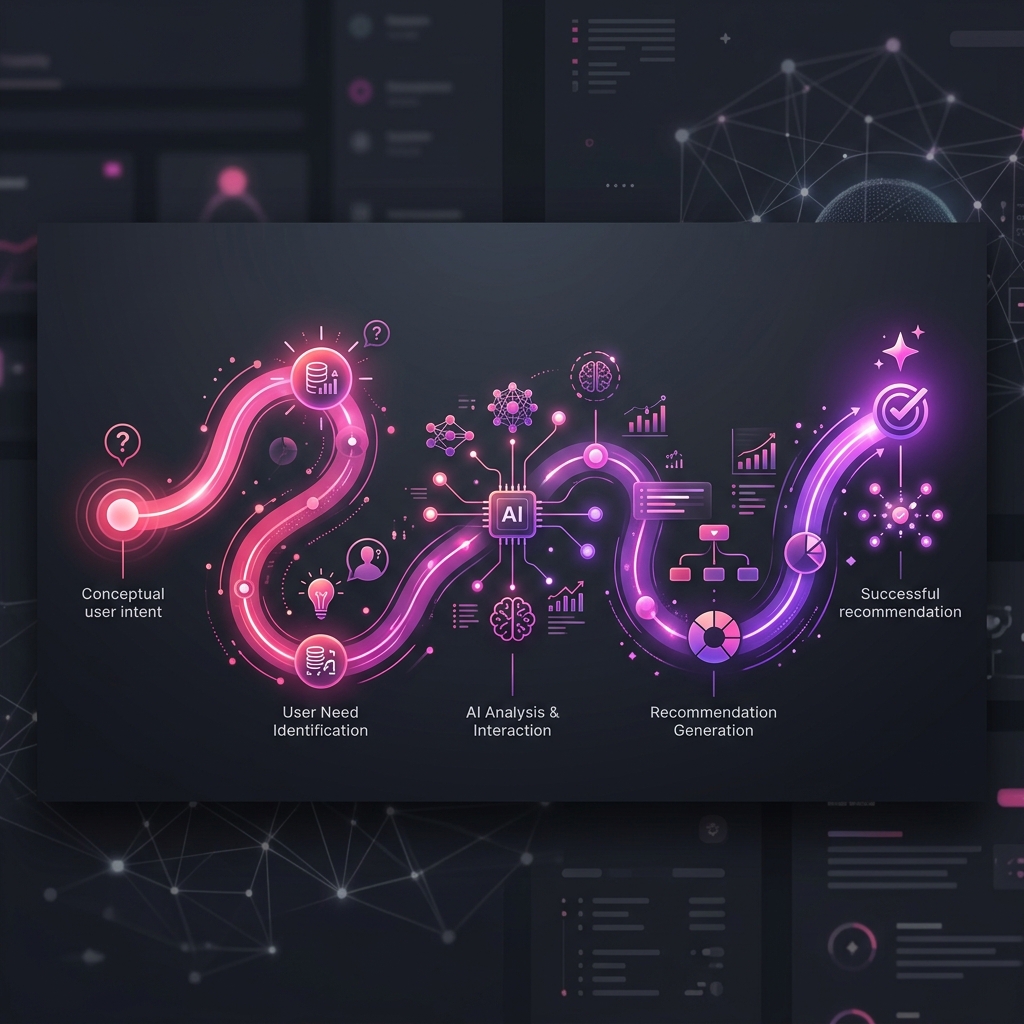
The product was designed around a streamlined, conversational flow that significantly reduces the time-to-decision.
Product Requirements
Based on the research and journey mapping, the MVP needed to satisfy three critical requirements:
- Conversational Input: It must accept long-form, messy natural language queries.
- Explainability: It must explain why a restaurant was recommended, citing specific details from the context.
- Graceful Degradation: If a user asks for a combination that doesn't exist (e.g., "Cheap Michelin star sushi in downtown"), the system must transparently relax constraints rather than showing an empty state.
Solution Design
I designed TasteFinder as a hybrid recommendation system. Pure LLM approaches are too slow, too expensive, and prone to hallucinations. Pure database filtering lacks nuance.
The solution combines deterministic database filtering (to rapidly narrow down by hard constraints like budget and location) with non-deterministic LLM reasoning (to evaluate the remaining candidates against the soft constraints like "vibe" and "romantic").
AI Recommendation Engine
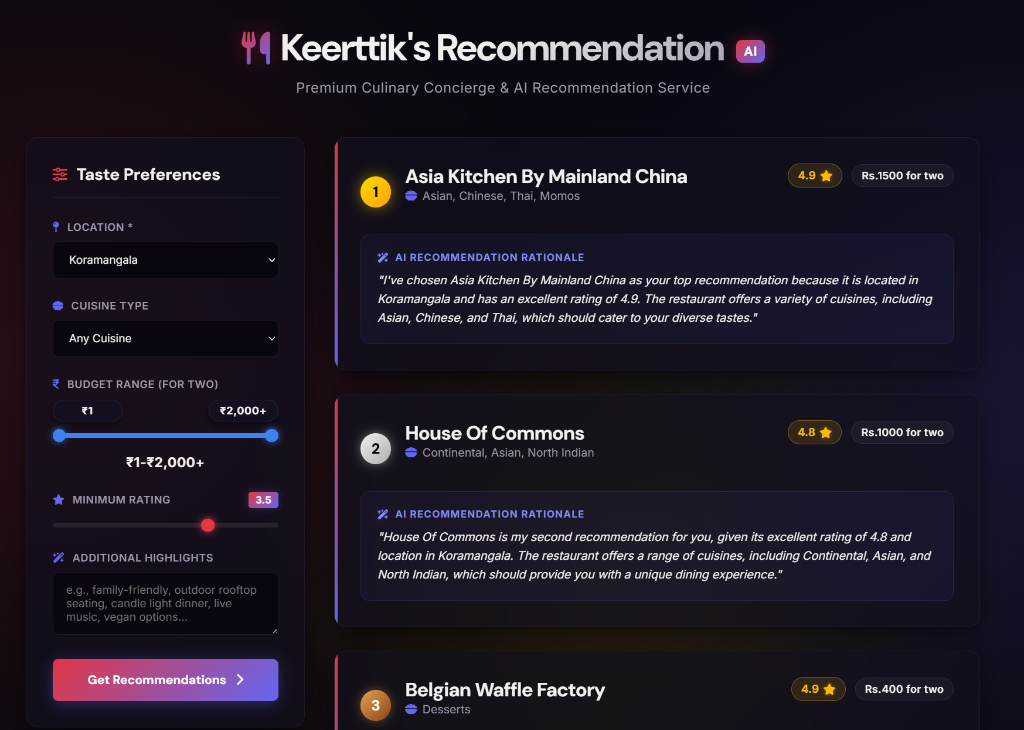
The architecture is completely hidden from the user. Under the hood, a FastAPI backend intercepts the query, translates the hard constraints into SQL, retrieves the top 20 candidate restaurants from a SQLite dataset, and then passes those candidates to a Groq-powered LLM. The LLM ranks the candidates and generates a personalized justification for the top 3.
Core Features
Intent Parsing
The AI extracts the underlying need from conversational text, identifying occasion, dietary needs, and social context before searching.
Cascading Query Relaxation
If strict matches fail, the system automatically drops the least important constraints (e.g., expanding the search radius) while transparently informing the user of the compromise.
Personalized Reasoning
Instead of generic blurbs, the UI presents a "Why we picked this" section, directly addressing the user's initial prompt.
Success Metrics
The primary success metric for this product is Time-to-Decision (the duration from opening the app to selecting a restaurant). Secondary metrics include the Recommendation Acceptance Rate and the reduction of Zero-Result Queries through graceful constraint relaxation.
Future Roadmap
The next phase of the product involves deep social integration—allowing users to filter recommendations based on places their network has highly rated—and seamless integration with reservation systems like OpenTable.
Reflection
TasteFinder taught me that end-to-end product design in the AI era isn't about slapping a chat interface onto an old problem. It's about designing an experience where the AI seamlessly bridges the gap between human intent and structured data, ultimately reducing cognitive load and delivering faster value to the user.