Swiggy Instamart: AI-Powered Category Expansion Strategy
Designed an AI-powered trust verification system that prevents 47% of users from abandoning the platform to check Amazon reviews, unlocking ₹80–340 Crores in annual non-grocery GMV.
The Problem: The "Verification Exodus"
Swiggy Instamart delivers groceries in 10 minutes, but 89% of its users never buy anything beyond milk, bread, and snacks — despite the platform listing electronics, beauty, pet care, baby products, and fitness gear.
This is not an awareness problem. Over 80% of users know these categories exist. The real problem is a systemic trust deficit: users trust the platform with ₹50 groceries but refuse to spend ₹1,500 on a trimmer because there are no reviews, no social proof, and no clear return policy.
47.3% of users leave the app to check Amazon reviews before buying non-grocery items, and most never come back. If they can't trust the platform with a ₹50 tomato, they won't trust it with an expensive trimmer.
The Process
A 12-stage, evidence-driven product management process spanning 4 weeks:
- AI Discovery Engine: Built a custom Gemini 2.5 Flash pipeline to analyze 342 user reviews at scale.
- Behavioral Research: Mapped shopping behavior, habit formation, and decision-making mental models through 6+ live user interviews and a quantitative survey (N=150).
- Evidence Synthesis: Formulated 4 competing hypotheses and validated the trust deficit as the primary digitally-solvable barrier.
- Solution Exploration: Generated 10+ concepts, scored via ICE/RICE, and selected one flagship solution.
- MVP Prototyping: Built and deployed a live AI-native MVP on Railway.app.
The Product Strategy: Instamart Trust Hub
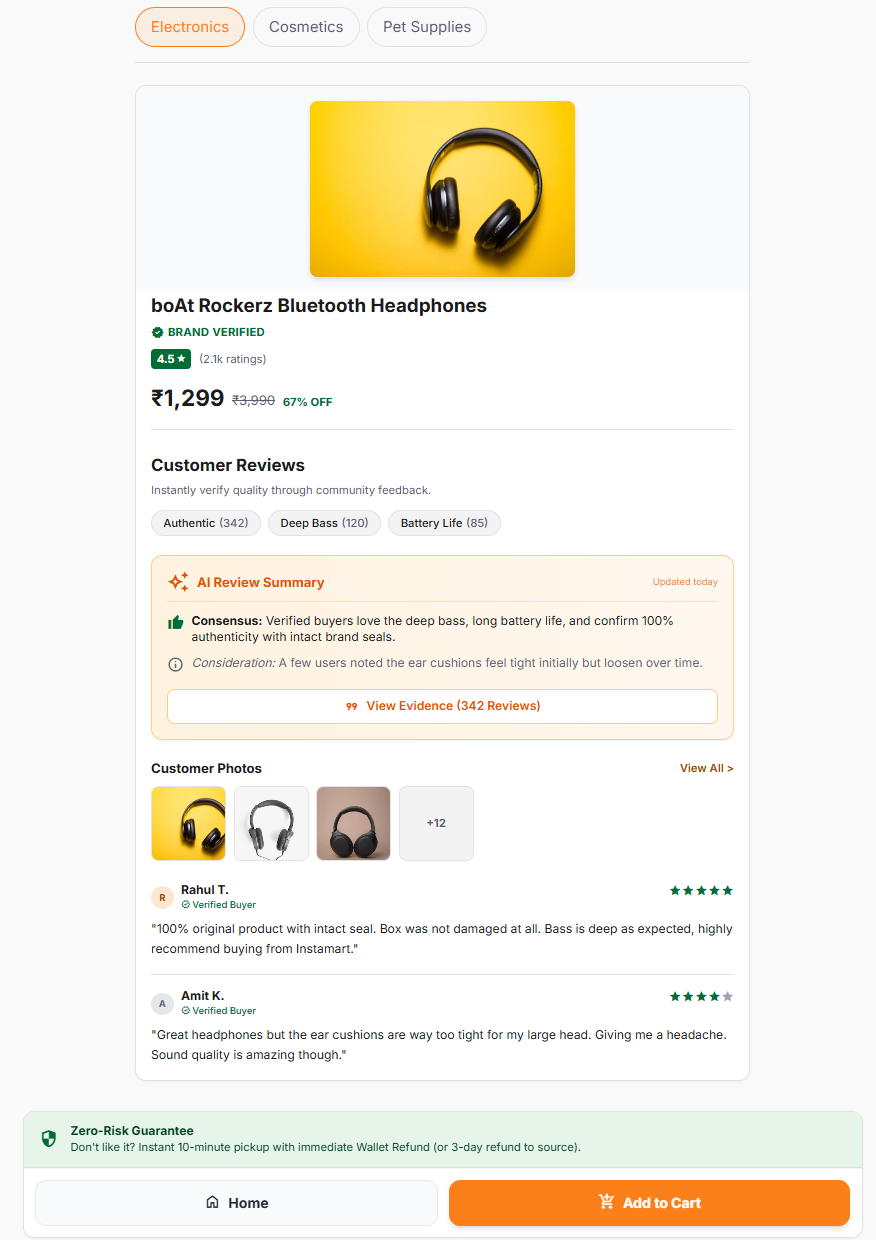
The vision is to bring Amazon-level product confidence to 10-minute commerce. The flagship product is the Instamart Trust Hub — a unified, AI-powered verification ecosystem embedded into every non-grocery Product Detail Page.
Phase 1 MVP: AI Review Summaries
A purely digital, software-buildable solution that directly attacks the Verification Exodus without requiring operational or logistics overhauls. It includes:
- 2-sentence AI-synthesized review summaries on every non-grocery PDP.
- Explainable citations linking every AI claim to real source reviews.
- Confidence threshold gating to prevent fabricated summaries.
Phase 2: Assurance Layer (Return Shield)
Visible return guarantees, context-aware return/refund policies powered by 10-minute reverse logistics, customer photo uploads, and review filters.
Phase 3: Intelligent Discovery Engine
ML-powered cross-category recommendations during grocery sessions built on top of the trust layer and purchase history.
Competitive Moat
The true moat isn't the AI (which is commoditized), but the compounding data flywheel. High-frequency grocery visits (3–5x/week) lead to Trust Hub exposure, resulting in in-app purchases. This triggers post-delivery review prompts, growing a proprietary review corpus that makes the Trust Hub even richer, driving higher conversion.
Expected Impact
By transforming the unit economics from a -₹6 loss on a grocery-only basket to an ₹82+ profit on a cross-category order, this strategy has profound business implications.
- Conservative Year 1 GMV: ₹80–120 Crores
- Full Potential Annual GMV: ₹340 Crores
- Users to Convert: ~5 million (bridging a 23.6% penetration gap)
- Non-Grocery Penetration Target: Increase from 11.4% to 35%
Key PM Skills Demonstrated
This project highlights rigorous product management principles, including:
- Evidence-Driven Decisions: Locked the problem statement only after achieving Executive Confidence (Level 5) evidence.
- Customer Empathy: Discovered the "Rotten Vegetable" Trust Bleed through qualitative probing, which was invisible in surveys.
- Prioritization Discipline: Chose to solve the digital trust barrier (H1) instead of the logistics barrier (H3) based on constraints and sequencing analysis.
- Responsible AI Product Thinking: Designed with 6 named failure modes, required citations, honest null states, and automation bias prevention.
- Metrics Design: Established North Star, input, output, and guardrail metrics with explicit ship/no-ship thresholds.