Investora: RAG-Powered Mutual Fund Intelligence
A case study on building a highly deterministic, retrieval-augmented generation (RAG) assistant for retail investors.
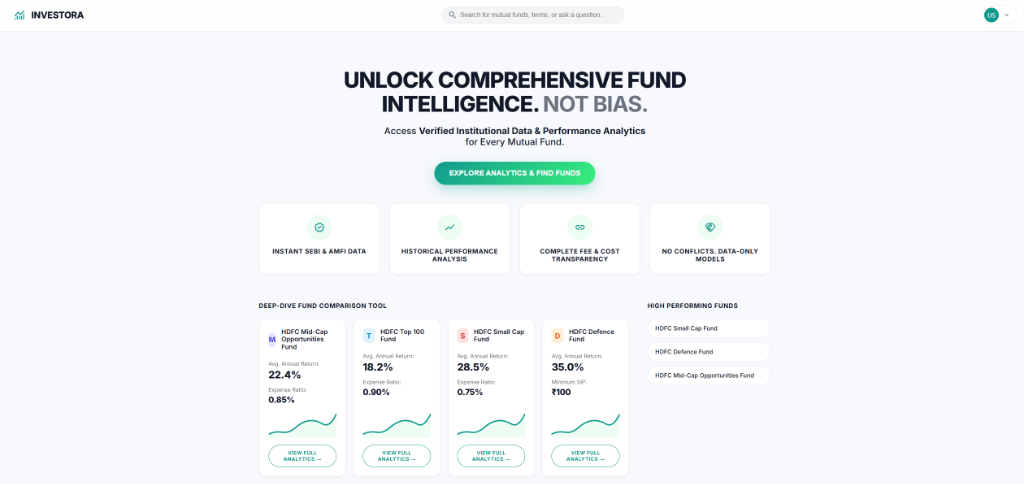
The Problem
Retail investors are increasingly participating in the market, yet they struggle to understand complex mutual fund information. Traditional prospectuses are dense, legalistic PDFs, while modern brokerages only provide surface-level charts.
When investors want to know, "How does this fund handle market downturns?" or "What is the exact exposure to mid-cap tech?", they face a wall of unreadable documents.
Financial inclusion isn't just about access to trading platforms; it's about access to understandable information.
Market Context
The wealth tech space has seen an explosion of AI integrations, but many suffer from hallucinations. Providing an incorrect answer about financial risk is far more detrimental than a hallucination in a creative writing app. The market needed a tool that was conversational but strictly grounded in verified facts.
Product Vision
To build a conversational interface that acts as a personalized financial analyst—capable of translating complex, verified mutual fund data into simple, actionable insights without generating unverified claims.
User Personas
- The Retail Investor: Wants simple explanations of risk profiles, expense ratios, and historical performance without jargon.
- The Mutual Fund Researcher: Needs to rapidly extract and compare specific holdings, sector allocations, and manager histories across multiple funds.
Solution Design
Investora was designed around a Retrieval-Augmented Generation (RAG) architecture. Instead of relying on the LLM's pre-trained memory (which is prone to hallucinations and outdated data), the system first retrieves verified documents from a proprietary database, and then uses the LLM solely to synthesize that exact text.
AI Architecture
The system was built with a clear separation between data retrieval and language generation to ensure absolute determinism.

Retrieval Pipeline
The core IP of this product lies in the retrieval pipeline rather than the LLM. Financial documents require specific chunking strategies. Splitting a document mid-sentence or separating a table from its header destroys the context. I implemented semantic chunking and metadata tagging to ensure that when a user asks about "expense ratios," the exact paragraph containing that data is retrieved flawlessly.
Key Features
Conversational Q&A
Users can ask natural language questions like "What makes this fund different from an index fund?" and receive answers grounded strictly in the fund's official prospectus.
Automatic Risk Summarization
The system extracts the legal risk factors from the documents and translates them into a clear, 3-point summary for retail investors.
Side-by-Side Fund Comparison
Users can query two funds simultaneously, and the LLM will generate a structured comparison matrix based on the retrieved documents of both funds.
Evaluation
To ensure trust, I implemented a strict evaluation loop. Using an "LLM-as-a-judge" framework, every response in testing was evaluated against the source document for relevance, faithfulness (zero hallucinations), and clarity. Responses that strayed beyond the provided context were penalized, leading to iterative prompt adjustments.
Future Improvements
The roadmap includes enabling multi-modal inputs (e.g., allowing users to upload a screenshot of their current portfolio for risk analysis) and proactive alerting, where the agent notifies the user if a new prospectus update changes the fund's risk profile.
Product Learnings
Building in the financial sector requires a fundamentally different mindset toward AI.
Financial products require trust and explainability above all else. "Mostly right" is unacceptable. If the model doesn't know, it must explicitly state so.
Reflection
Investora reinforced that successful AI products are rarely just "wrappers" around an LLM. The true product value is created in the data ingestion, the retrieval engineering, and the guardrails placed around the model. By prioritizing determinism over raw generative capabilities, we created a tool that investors can actually trust.