Trippy: Orchestrating Autonomous Workflows
A case study on moving beyond chatbots to build a multi-agent system capable of complex, multi-variable decision making.
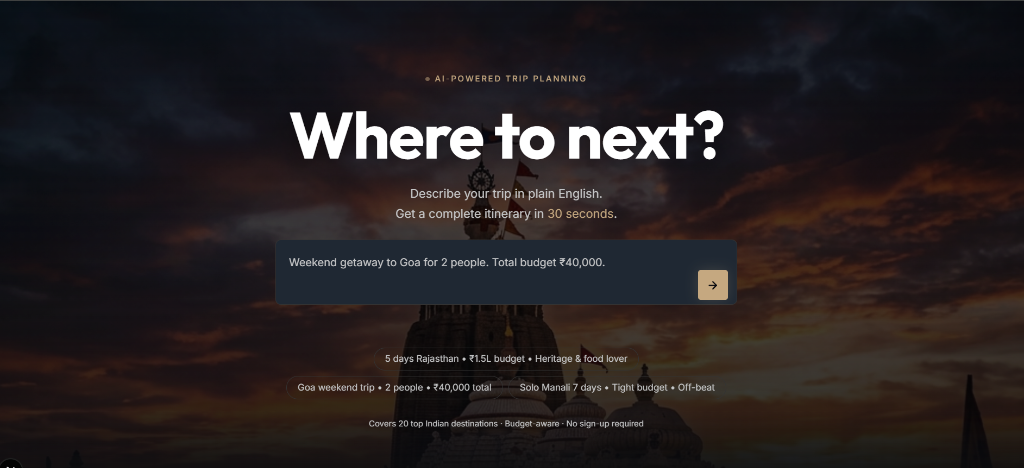
The Problem
Travel planning is fundamentally a multi-variable optimization problem. Users have to balance budgets, flight schedules, hotel availability, local weather, and personal preferences simultaneously.
This requires humans to spend hours context-switching between 10+ tabs (Google Flights, Airbnb, Weather apps, TripAdvisor) to manually synthesize a feasible itinerary. Standard ChatGPT fails at this because it cannot actively browse live pricing or adapt to real-time constraints effectively in a single prompt.
Vision
To build an autonomous AI system that doesn't just "suggest" destinations, but actively plans the logistics by delegating tasks to specialized, API-connected agents working in parallel.
User Scenario
Imagine a user inputting: "I want a 5-day trip to Japan next month under $2000, focusing on culinary experiences, but avoid anywhere that's expected to rain heavily."
A single LLM cannot answer this accurately. It requires live flight data, live weather forecasts, and contextual routing. It requires a system.
Multi-Agent Architecture
I designed the product using a hierarchical multi-agent architecture. Instead of one monolithic prompt, the system relies on specialized nodes that communicate with each other.

Planning Workflow
The workflow operates autonomously once triggered:
- The Manager Agent: Acts as the orchestrator. It receives the user prompt, breaks it down into sub-tasks, and spins up worker agents.
- The Flight Agent: Queries pricing APIs (e.g., Amadeus) to find optimal routes within the $2000 budget.
- The Weather Agent: Checks historical and forecasted weather patterns to eliminate rainy regions.
- The Local Guide Agent: Synthesizes the filtered locations into a day-by-day culinary itinerary.
Decision Making
The true power of this system is inter-agent communication. If the Flight Agent reports that flights to Tokyo consume 80% of the budget, the Manager Agent dynamically instructs the Local Guide Agent to re-route the itinerary to Osaka or Fukuoka to maintain the overall constraints. The system checks back with the user only for critical approvals (Human-in-the-Loop).
Key Features
Autonomous Task Delegation
The system independently decides which specialized agent is required to fetch specific data points without user intervention.
Parallel API Execution
Worker agents execute tasks asynchronously, pulling live data from multiple external sources simultaneously to reduce latency.
Constraint Optimization
The orchestrator actively resolves conflicts between budget, schedule, and preferences before presenting the final output.
Technical Architecture
The system was built leveraging modern AI orchestration frameworks:
- Framework: LangChain and CrewAI for defining agent roles, tools, and execution sequences.
- LLM: Groq/Llama-3 for high-speed reasoning and tool-calling.
- Backend: FastAPI to handle the asynchronous workflow and stream intermediate thoughts back to the UI.
Future Scope
The immediate next step for this product is Direct Execution. Moving beyond generating an itinerary, the agents will be equipped with browser automation tools (like MultiOn or Playwright) to securely execute the checkout process for flights and hotels on behalf of the user, achieving full autonomy.
Reflection
Building Trippy taught me that the future of AI products is moving away from conversational chatbots and toward autonomous agentic systems.
Building these systems requires a paradigm shift for Product Managers: you are no longer designing user flows; you are designing workflows for machines. You must think in terms of state management, error recovery, and API orchestration.